How to become a 100x Developer (and earn real money doing it)
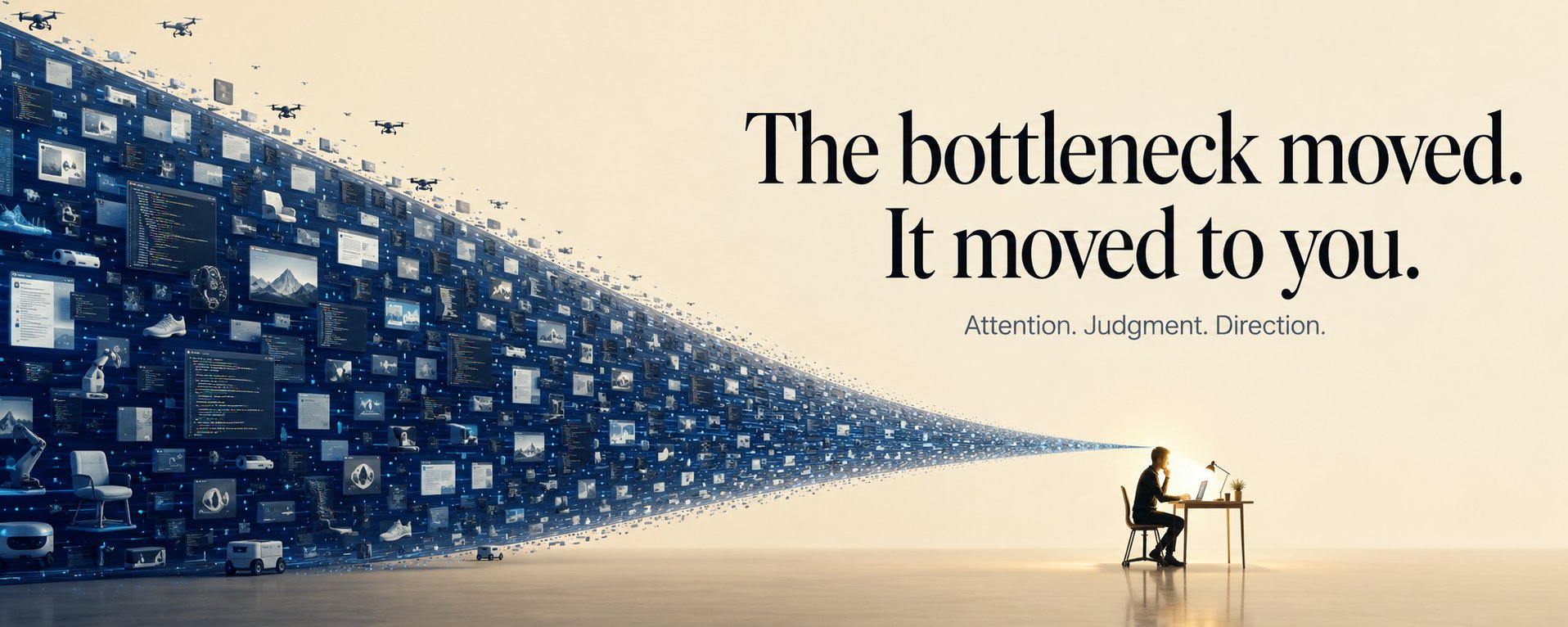
Ask an economist what happens to the price of anything when its supply goes to infinity. The answer is: it goes to zero.
That's what just happened to code.
The act of producing software, the thing our entire value was built around, is now nearly free. And here is the rule markets teach you: when something becomes free, the value doesn't disappear. It moves. To whatever is still scarce.
Almost every single one of us has noticed, and almost no one has moved their energy to where the value went.
We did the opposite. The most natural (and most insane) thing possible. We doubled down. Better prompts, more products, more agents running in parallel. We got busier than we've ever been. I'm sure you know the feeling.
And every bit of that cheap, infinite code had to flow back through the one thing that didn't get cheaper, didn't scale, and couldn't be cloned: you.
That's the whole shift, and almost nobody sees it.
When code is infinite, the scarce thing isn't writing code faster. It isn't even having better ideas. Those are getting cheap too.
The scarce thing:
Your attention. Your judgment. Your direction.

It's the one resource that doesn't scale, can't be generated, and only gets more precious the more execution you unleash.
Knowing which of the infinite possible things is actually worth doing.
Judging the handful of calls no machine should ever make for you:
- What to build
- What to ship
- What to kill
- Where the bar sits
That judgment lives in exactly one place. Your head. And there's exactly one of you.
Now, here is the trap nobody saw coming. Infinite execution doesn't free you. It buries you. More agents, more products, more activity, all of it flowing toward the one human still in the loop, each single piece demanding a look, a call, an approval, ...
Abundance of execution creates a scarcity crisis of attention.
The bottleneck didn't disappear when code got free. It just moved to you. And it got dramatically worse.
That's the entire job of the thing I built. I call mine Heimdall, after the vigilant guardian from Norse mythology who sees everything coming.
I think everyone should have their own. So I'm sharing exactly how I built it, so you can build your own.
This is my Direction Cockpit. Its one job is to decide, continuously, what deserves my human attention. And route everything else away from me.
I - The three things burying you
Before I show you how it works, you need to see what it's saving you from. The direction cockpit isn't really a tool. It's a defense against the three habits that are burying you right now.
None of them are a skill problem. You were trained into all three, and they made perfect sense back when you were the one writing the code.
The Inspector reflex:
You were taught to own every line. Review everything. Be careful. You're responsible for what ships. You don't even read most of it now. But nothing ships without your nod, and every mess lands back on your desk. It feels responsible. You're not a builder anymore. You're a checkpoint. And a checkpoint moves only as fast as one tired person reading.
The output trap:
Somewhere you started measuring yourself by how much you ship. Commits. Features. Busy days. It feels like progress. But shipping more of the wrong thing, faster, was never leverage. It's a treadmill, and someone keeps turning up the speed. Busy was never the same as free.
Building with no direction:
When building is free, you build constantly. Another feature. Another refactor. Another tweak. Another product. It looks productive. But execution pointed at nothing is just expensive motion. Without something that says "this matters, this doesn't", you will fill every hour with work that never needed to exist.
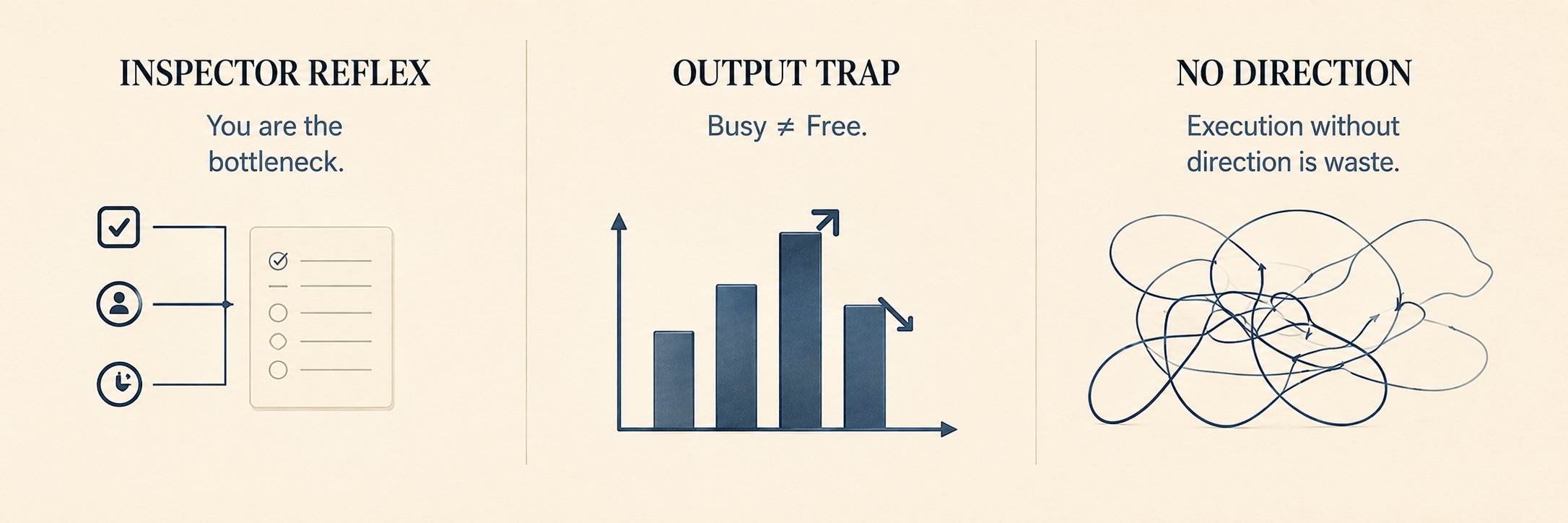
Look at what all three share: they keep you in the loop, on everything, forever. They take the one scarce thing you have. Your attention. And spend it on every single trivial task.
This direction cockpit I'm about to show you reverses that. It pulls you out of the loop on purpose, everywhere it's safe to take you out of it, until the only things left seeking your attention are the ones that actually need you, a human.
Here's how it does it.
II - What the cockpit actually does
Let me walk you through mine, piece by piece, because the magic is in how all the pieces work together.
It starts before I open my laptop:
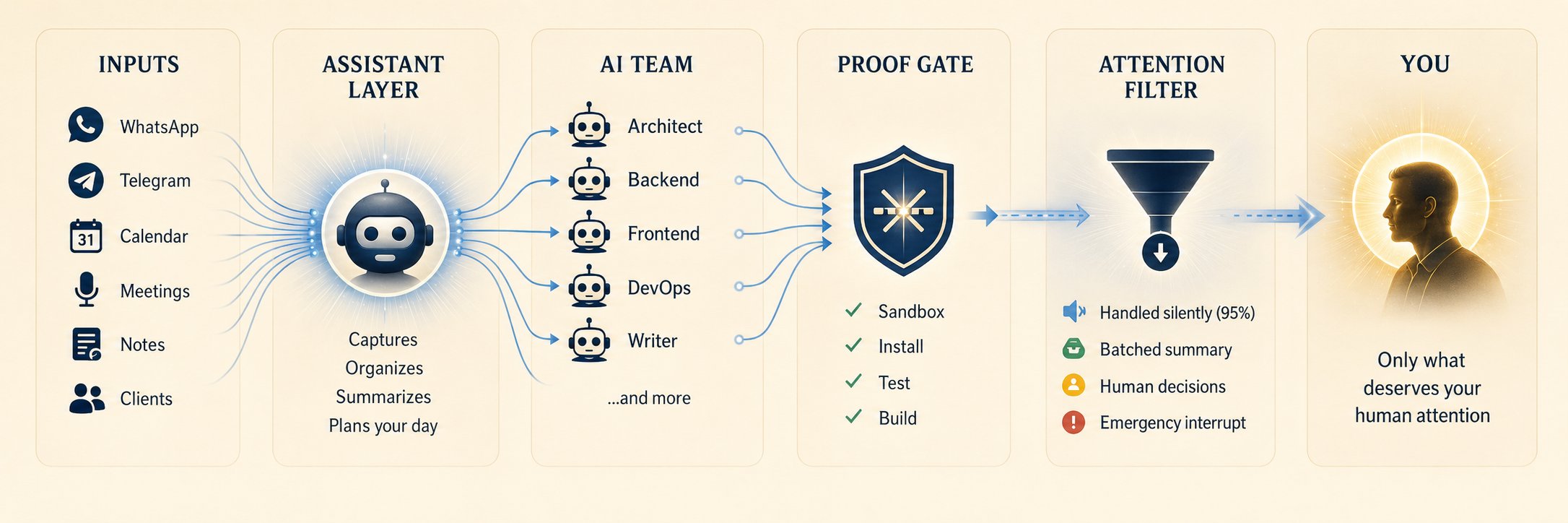
The front of the system is an assistant layer (I recommend using Hermes as the foundation), wired into the apps my life already runs on: Whatsapp, Telegram, my calendars, Granola (or whatever records your meetings).
It listens to my whole day and turns the mess into organized work. I promise a client something on a call? It's captured before I hang up. A deadline lands on my calendar? Logged, against the right project.
And it's proactive. Every morning it hands me "here's your day". One calm assistant in front of my whole operations, instead of ten dashboards I have to remember to check. It isn't an inbox. It's my own Executive Assistant.
A software team that never sleeps:
This is the part that makes people's jaws drop. The work itself is done by a team made entirely of AI agents. They talk to each other. They hand off sessions, picking up exactly where the last one left off. There's an architect, backend, frontend, devops, writer, ... , each running on whatever model is best for its job, totally model agnostic. Not tied to any provider.
They pick up tasks, build them, test them, and ship them, around the clock, in the background, while I'm doing literally anything else.
I don't manage them. I don't pass messages between them. I say what I want, and the team figures out the rest.
I have worked on several projects with professional development agencies before AI, and this feels exactly like having one working for you 24/7. For the price of a few subscriptions instead of multiple (high) salaries.
Nothing ships on trust. It ships on proof.
"You let AI merge code to your real products?"
Yes, and here's why it's safe. Remember the checkpoint from a minute ago, the one that moves only as fast as one tired person?
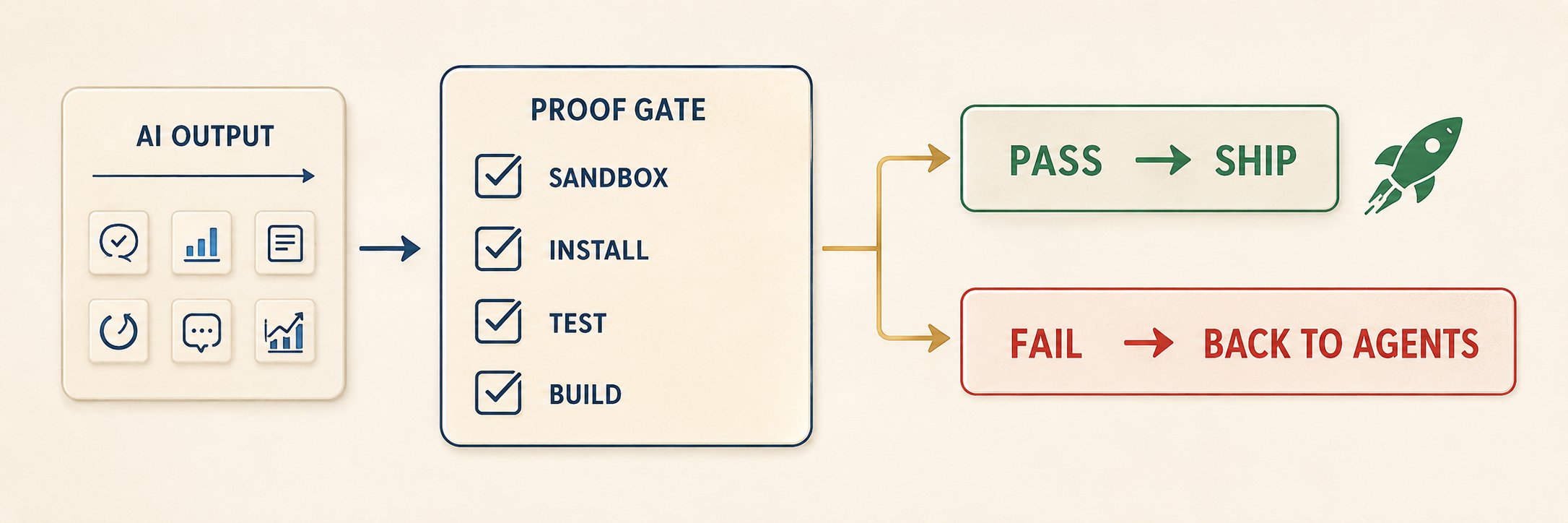
I didn't get rid of the checkpoint. I replaced the tired person with a system. Every change runs through an automatic gate before it ships: sandboxed, installed, tested, built from scratch, the same way every time. Green, it goes. Red, it never reaches me. The team fixes it and tries again. No "looks fine to me". No bad days.
That's the whole trick: I don't trust the code. I trust the gate. The checkpoint was never the problem. You being the checkpoint was. Hand that seat to something that checks every line identically and never gets tired, and you can finally put down the inspector's role.
A filter stands between me and the noise.
All day, things happen across the whole portfolio. Builds finishing, products getting traffic, signals coming in, clients texting, teammates asking for features,...
A normal dashboard shows you all of it and calls that visibility. That's not help. That's a louder bottleneck.
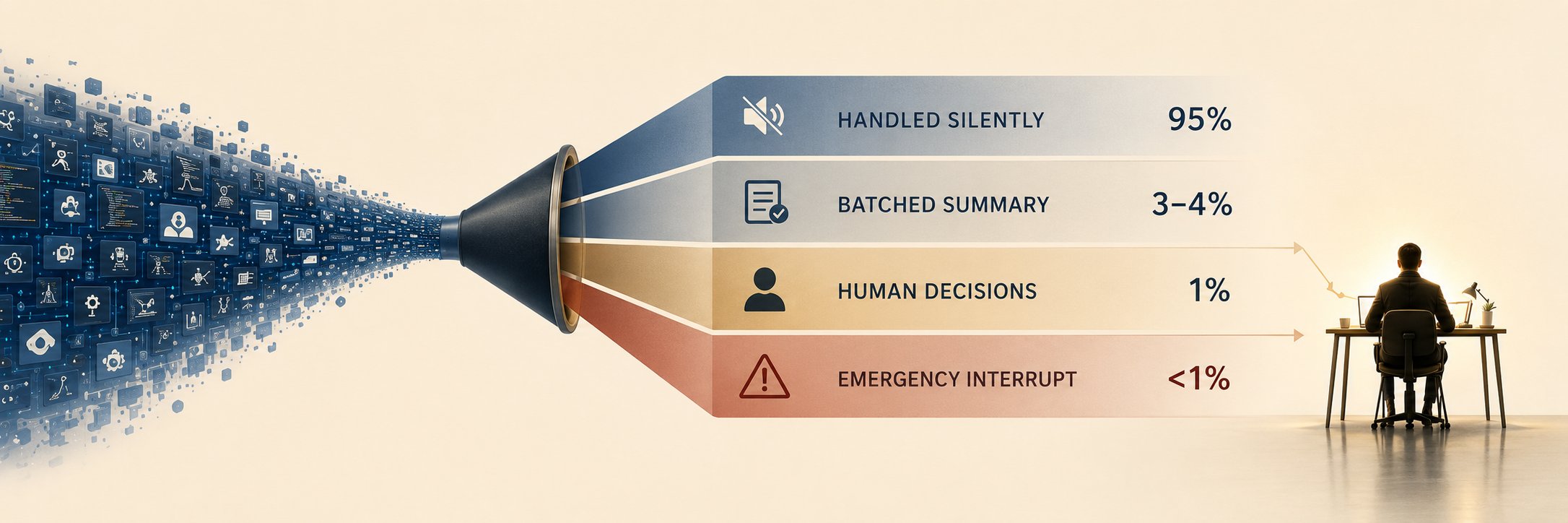
So the cockpit sorts everything into four buckets: it handles about 95% silently (I never see it), batches the routine into one short summary, surfaces the real decisions into one short list, and interrupts me only for a true emergency.
The best pixel on the whole screen is a single line:
"handled 47 things - 0 needed you."
And it doesn't just wait for orders.
Every product has a North Star. One detailed memo on what "great" means for it. A loop runs against that memo, constantly asking, "what's the most valuable next move toward this?". The safe moves, it just builds and ships.
And the North Star is alive. My assistant keeps feeding it everything after my filtering (my notes, whatsapp threads, what clients and teammates are asking for that product), so the target updates as the real product does.
Now, the real decisions like pricing, a product-shape call, anything that needs taste. It hands me as a ranked choice. So the system doesn't just filter my attention. It sets the agenda, and brings me only the calls that move the needle.
That's the whole machine. And here's what it feels like to run: not a busier screen. A quieter one.
Where the money comes from.
I won't throw fake numbers at you, but the logic is simple. And it's the whole reason this matters.
The number of products one person can run was never capped by how fast they code. It was capped by how much attention each one demands. Drive the attention per product toward zero, and one person can run ten instead of one. Same hours. Same head. Same you. Ten times the surface out there earning. That's the 100x. And it was never about typing faster.
III - Which level are you on?
You're not starting from zero, and you're not building it all at once. You're climbing a ladder, and each step is one more place the work stops depending on you. Find where you actually are.
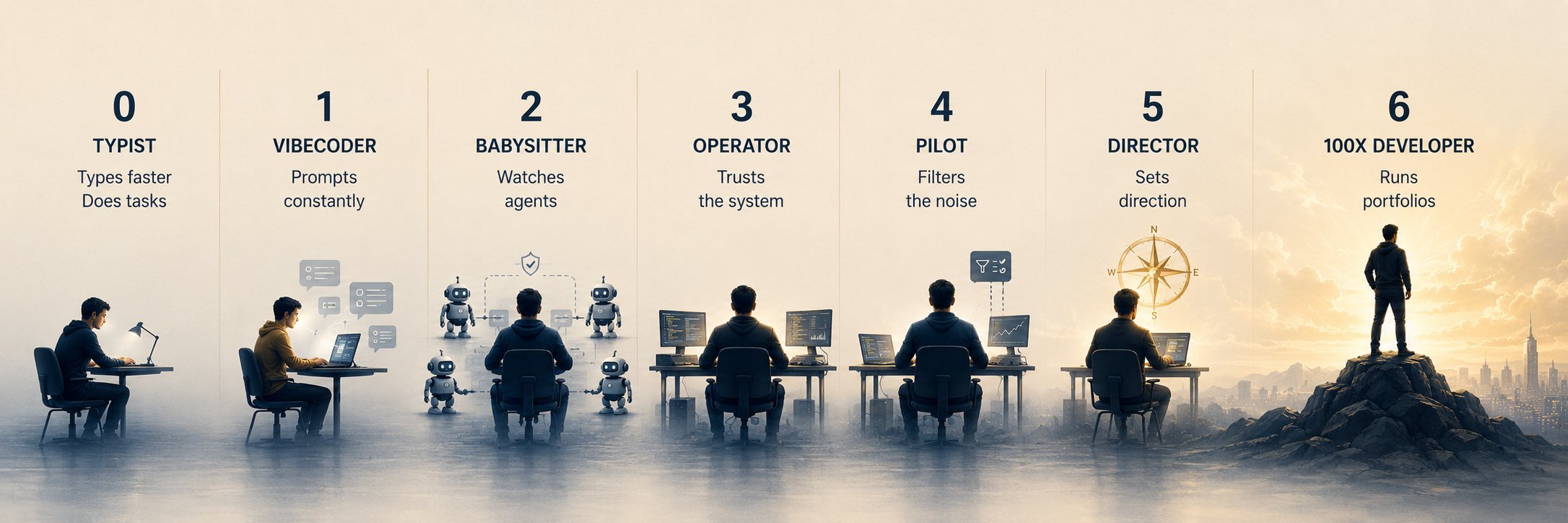
Level 0 - The typist.
AI is your autocomplete. You still write the software yourself. It just helps you type faster. That's a sharper tool, not leverage. Not many left in this level nowadays. Just the coding purists.
Next: stop typing, start driving the AI in plain language.
Level 1 - The Vibecoder.
You live in the chat window. Prompt, accept, run it, it breaks, prompt again. The AI writes most of it now, but your hand is on the wheel every second, and the moment you stop steering, everything stops.
Next: hand off whole tasks, not keystrokes.
Level 2 - The Babysitter.
You give an agent a real task and let it run... then watch it like a hawk, approve every step, and clean up every mess yourself. You delegated doing and kept all the checking. This is where almost everyone is. And it's the worst step on the ladder, because now you're busy and still the bottleneck.
Next: build the gate, so a machine checks the work instead of you.
Level 3 - The Operator.
You built the gate. Work now ships when it passes, not when you bless it. You're finally out of the reviewer's chair. But you've still got both hands on the controls: you queue every task yourself, and you watch every result land. And now that shipping is cheap, there's far more of it. More changes, more activity, more signals coming back at you than ever before. You're not reviewing anymore, but you're buried in updates.
Next: build the filter, so you stop having to watch all of it.
Level 4 - The Pilot.
The filter handles the 95% silently and surfaces only what needs a human. Your screen is quiet for the first time in years. You touch the controls only when it matters. But the system is still reactive. It only moves when you push it.
Next: give it a north star and an engine, so it moves on its own.
Level 5 - The Director.
Your system has a north star and generates its own work: it proposes the next best move, ships the safe ones, and brings you only the real forks. It runs 24/7 whether you show up or not. You direct one product that improves itself while you sleep.
Next: clone the whole cockpit system onto product number two.
Level 6 - The 100x Developer.
Now there's no ceiling on how many products you run, because each one barely touches you. A handful of products. A couple of real companies. The side projects you never had time to start. All running at once, each with its own cockpit (or all centralized in one as I do). Each sending you only the few calls that genuinely need you. You're not coding any of them. You're not reviewing any of them. Not even really managing them. You're directing all of them at once.
That's the thing the internet keeps swearing is impossible. It isn't. It's just the very top of a ladder almost nobody has climbed. Because they're still on Level 2, watching agents like a hawk.
Be honest about your Level, then do the one move that gets you up it. Not the whole ladder. At Level 2 you don't need an engine. You need a gate. Build that, only that, this week.
But there's one move that pays off no matter where you stand, costs nothing, and needs zero infrastructure: write your North Star for each of your projects. It's the one input no machine can produce for you, and every step above Level 4 is worthless without it.
Here's the prompt I'd paste into your agent to do it right. Steal it:
Help me write the North Star for one of my products - a short, concrete definition of what "great" means, specific enough that someone who's never met me could make the same calls I would.

Interview me one question at a time. Cover: who exactly this is for (be specific — not "developers," but which ones); the single outcome they "hire" it for; what "great" looks like in their words, not mine; the one thing I'll never compromise on; and the line that would make me kill it.

Then write it as a one-page memo — ruthless and specific, no vague adjectives like "simple" or "fast" unless you define them concretely. End with three things this product must never do.
Do that today, and you've done the part that actually needs a human. The rest is wiring. I'll write more about it. One Level at a time. In the articles to come.
The bottleneck was never the code.
For twenty years, the constraint was building. So we optimized it, sharpened it, and finally handed it to machines that do it for free.
The bottleneck didn't disappear. It moved to the one place it could. To you. To your attention, your judgment, your direction. The one thing that can't be cloned, can't be generated, and only gets more precious the more execution you unleash.
You can keep spending it the old way: reviewing everything, the hardest-working bottleneck in your own company. Or you can build the thing that guards it. That handles the 95% silently and brings you only the calls that are truly yours to make.
Code is free now. Your attention isn't.
Build the cockpit that protects it.
First one of more articles to come.
— Pablo